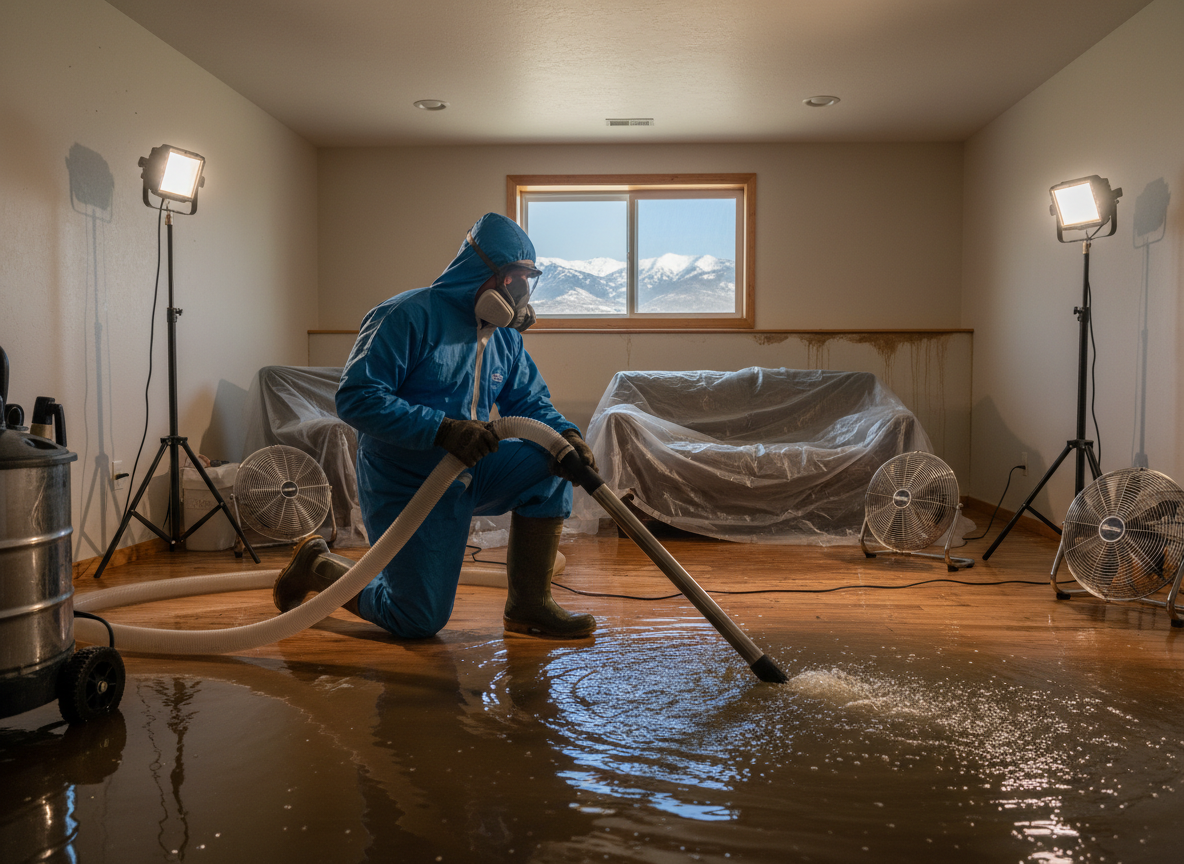
In Heber City’s mountain climate, sudden warm spells after heavy snow can send meltwater into basements along Lake Creek and older stock in Downtown Heber City. We arrive with truck-mounted extraction units sized for the tight driveways and steep grades common in North Village. Removing standing water within the first hours prevents saturation of the log and frame construction typical here, where moisture travels quickly along chinking and into rim joists.
Terrain around Jordanelle State Park and Wasatch Mountain State Park often means septic systems and shallow wells sit close to foundations. During extraction we map these utilities first so we do not pull contaminated water into living spaces. In Midway and Park City second homes left unheated through winter, ice dams create hidden leaks that surface only when temperatures rise; our moisture meters locate the full extent before walls are opened.
Wasatch County building practices from the 1970s onward frequently used particleboard subfloors that delaminate after even brief flooding. We document every layer removed and coordinate with local disposal rules at the Heber Valley landfill so homeowners avoid extra trips. Equipment placement must account for narrow hallways in historic cabins near the Heber Valley Railroad; we use portable desiccant dryers that fit through standard doors without dismantling railings or decks.
Technician insight
In Heber City, the thing that catches most people out with Emergency Water Removal is how fast snow-melt from the benches above North Village and Lake Creek finds old foundation cracks in 1970s cabins. Homeowners often stop at the visible puddle on the basement slab and miss the water that has wicked six feet up the particleboard under the carpet pad. We pull baseboards on day one because once that material swells it pushes drywall tape loose within forty-eight hours.
Mid-winter Pipe Burst in Downtown Heber City
A supply line froze and split behind a kitchen wall in a 1982 home near Main Street. Water migrated under the oak floor into the crawl space and reached the shared wall with the neighbor. We extracted standing water, removed saturated insulation, and ran drying equipment for four days until readings matched unaffected rooms. The floor stayed intact and the shared wall required only new drywall on one side.
How it works
- 1
Arrival and Safety Check
Technician reaches the property, shuts off water source if still flowing, and verifies electrical safety before any extraction begins.
- 2
Standing Water Removal
Truck-mounted and portable pumps pull bulk water from floors, sumps, and crawl spaces while protecting nearby finishes.
- 3
Moisture Mapping
Infrared cameras and pin meters locate hidden saturation in walls, subfloors, and insulation around the affected footprint.
- 4
Drying and Monitoring
Air movers and dehumidifiers are staged; daily readings continue until materials return to documented dry standards.
Pricing
Cost depends on water volume, affected square footage, and how many days drying equipment must remain on site.