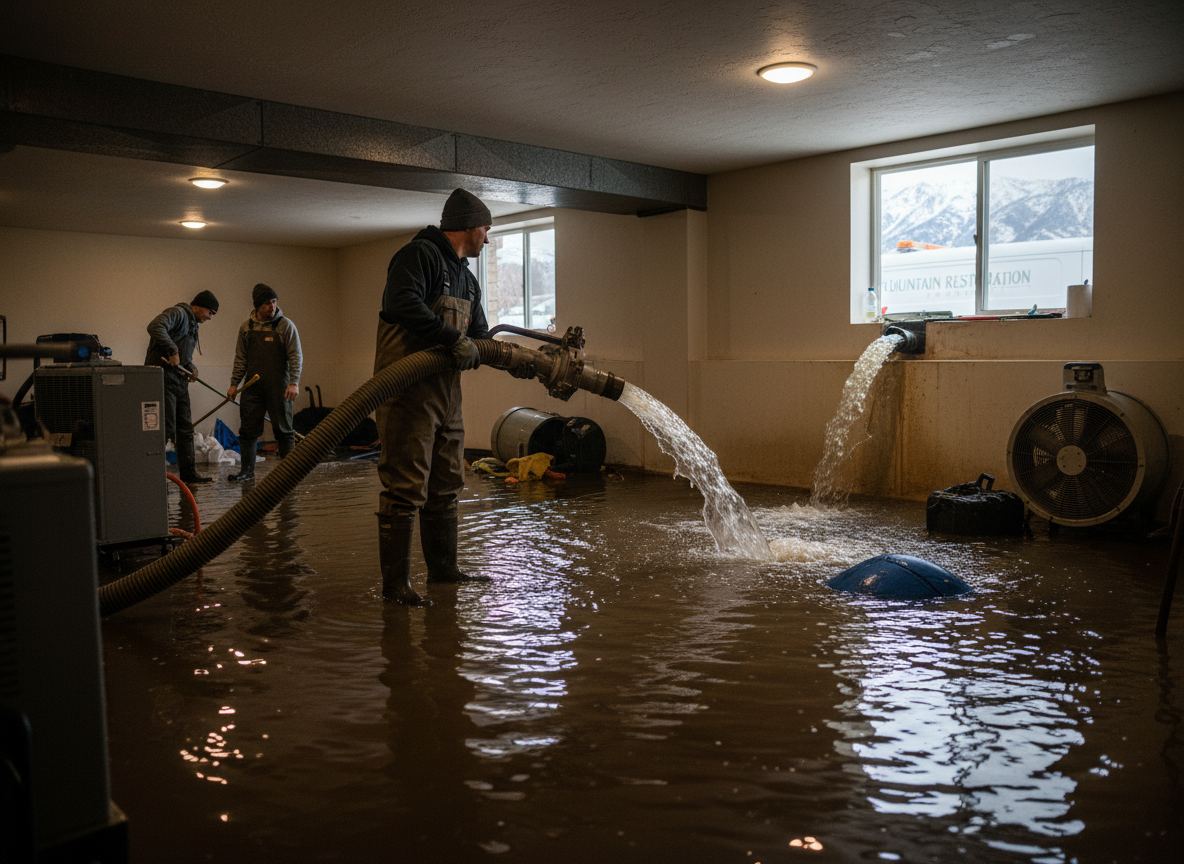
Water extraction in Heber City must account for the sudden volume of snowmelt that runs off Wasatch Mountain State Park slopes and pools against foundations in North Village and Lake Creek. Older homes common in these neighborhoods often have crawl spaces and basements with dirt floors or partial concrete that trap water against wooden sills. Technicians use truck-mounted extractors to pull standing water first, then subfloor drying mats to reach moisture trapped under hardwood and laminate installed over the past thirty years.
Near Jordanelle State Park and along the Heber Valley Railroad corridor, properties sit on sloped lots where spring runoff can enter through window wells and garage thresholds. Extraction crews check for water that has wicked into insulation behind baseboards and under kitchen cabinets, areas that stay damp long after visible puddles disappear. Portable extractors and air movers are positioned to avoid pushing moisture into adjacent rooms, especially in compact layouts typical of Midway-adjacent builds.
Mountain winters bring repeated freeze-thaw cycles that crack older stucco and allow water to enter wall cavities in Downtown Heber City homes. Extraction protocols include removing base shoe molding to access the bottom plate and using moisture meters to confirm drywall has dried below 15 percent before any wall cavity is closed. Crews also extract water from carpet padding in finished basements where radiant heat lines run close to the slab, preventing hidden corrosion on those lines.
After initial extraction, dehumidifiers sized for Wasatch County humidity levels run continuously to pull residual moisture from hardwood floors that expand when saturated. Technicians document moisture readings at multiple points in each room so homeowners in Park City commute properties can see progress before any reconstruction begins.
Technician insight
In Heber City, the thing that catches most people out with Water Extraction is how quickly snowmelt from the surrounding peaks soaks into the older dirt crawl spaces under North Village homes. Homeowners often stop at the visible puddle and miss water that has already wicked into the rim joists, which then leads to sagging floors once the wood starts to rot.
Spring Runoff in Lake Creek Basement
Heavy overnight snowmelt sent water under the garage slab of a Lake Creek home. Inspection showed moisture had reached the laundry room subfloor and base plates. Extraction crews pulled standing water, placed drying mats under the flooring, and ran dehumidifiers until readings dropped below 12 percent. The homeowner avoided floor replacement and returned to normal use within five days.
How it works
- 1
Initial Assessment
Technicians arrive within hours and map water migration through floors and walls using moisture meters at the Heber City address.
- 2
Standing Water Removal
Truck-mounted pumps extract bulk water from basements and crawl spaces before it spreads to unaffected rooms.
- 3
Subfloor and Cavity Extraction
Drying mats and injectors pull trapped moisture from under flooring and behind baseboards common in local housing stock.
- 4
Final Moisture Verification
Readings are taken again to confirm levels have returned to normal before equipment is removed.
Pricing
Upfront quotes are given after inspection because extraction volume and hidden moisture vary widely by property age and location in Wasatch County.